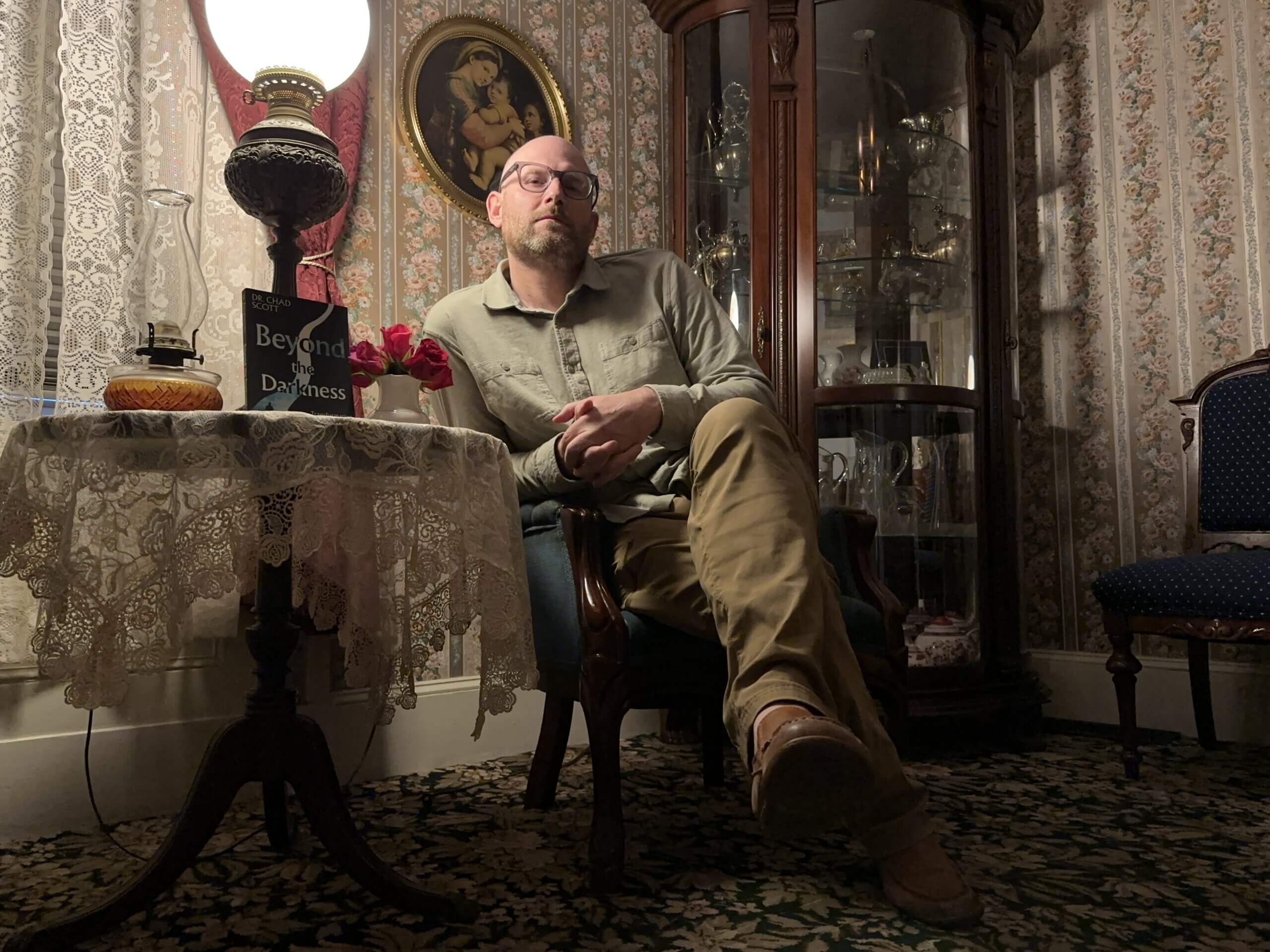
By Chad Scott, PhD, Therapist and Author of the book, Beyond the Darkness: Transformative Journeys Through Dark Tourism
I recently traveled to Boston for a conference hosted by trauma expert Bessel van der Kolk. Since I like to mix continuing education with my love of travel, I worked dark tourism into the trip.
I’ve always found that when I stand in places where people suffered or died, approaching them with empathy and reverence, I sometimes discover pieces of myself that help me better understand my own life. A touch of shadow integration, I suppose. I think of it as reflective dark tourism: using encounters with difficult places and histories not simply to observe the darkness, but to reflect on what it stirs within us.
So I rented a car and hit the road, visiting a variety of dark sites in and around Boston.
Lizzie Borden has fascinated those drawn to mystery and the macabre for well over a century. Not unlike O.J. Simpson, she was found guilty in the court of public opinion despite being acquitted.
I arrived in Fall River and headed to the cemetery. It held a unique resident: Lizzie Borden herself.
Her grave, marked “Lizbeth” on a small marble headstone just a few inches tall, sits next to that of her sister Emma. I couldn’t help but wonder what Emma might think about sharing eternal rest with the woman presumed to have murdered their father and stepmother. Later, I would find out that the sisters remained close for many years after the murders. Eventually, they had a falling out.
I knew little about the gruesome axe murders that claimed the lives of Lizzie and Emma’s father and stepmother before my visit to Fall River. I had heard the infamous rhyme about Lizzie giving her mother 40 whacks and then, when she saw what she had done, giving her father 41, though the actual number of blows was much lower.
Standing at her grave, I was hoping to feel something. I’ve toured many cemeteries and other places of burial, and something in me almost always feels reverence. It’s as if I’m gifted a few meaningful minutes with people who once walked the earth just as I am now, and in those moments, the past seems to speak. I wanted to feel some kind of connection or conversation with Lizzie, but it just didn’t happen. I honestly didn’t feel much of anything.
Yet something else struck me: the final resting place of her father, Andrew, and stepmother, Abby. Surely this must feel like an act of blatant disrespect to the victims. A daughter not only killing, but brutally disfiguring the faces of her parents—buried right next to them?
I parked across the street from the Lizzie Borden House and made my way around to the back. The house looked just as I had imagined: old, large, wooden, and dark green. But what caught me off guard were the surroundings. I had pictured a spacious yard with a barn out back, the place where Lizzie claimed to be during the murders. Her alibi? Eating a peach. Instead, I found a modern building housing a gift shop and the check-in area for tours. I then walked next door to the Miss Lizzie Coffee Shop, which has since relocated, to kill something myself—time. I was an hour early for my house tour.
I sipped my coffee as I walked around the rest of the shop, which had paintings by local artists and other macabre goods. That’s when I ran into the friendly owner, Joe. He asked if I wanted a free tour.
I had heard about another murder associated with the Lizzie Borden house, but I hadn’t realized it happened here, not there. The coffee shop stood on the site of what had once been the home of Dr. Dolan, the medical examiner who arrived at the Borden house after the murders in 1892.
According to Joe, Lizzie may not have killed her parents after all. He shared a theory I hadn’t heard before.
The theory? Lizzie’s uncle, John Morse, did it. Some believe he had a motive tied to a property matter—a topic he and Andrew supposedly discussed the night before the murders.
Joe motioned for me to follow him, and together we descended the narrow stairs into the dim basement office once used by Dr. Dolan. Joe let me sit at the table and began explaining the significance of the room. I didn’t hear a word of it.
Poor Lizzie Borden, I thought. For over a hundred years, she’s been found guilty in the court of public opinion. I had to stop myself and reframe my thoughts; maybe she was guilty.
But what if she didn’t do it?
What if she were innocent and had to live the rest of her life under the weight of assumed guilt?
I was having feelings of sadness for Lizzie Borden. Now that was unexpected.
We moved into the next room—a simple, damp, dark concrete space. That’s when Joe told me the story. I already knew that two children had drowned at the hands of their mother.
Joe explained that the woman likely suffered from postpartum depression. I wondered whether psychosis may also have been involved. As a therapist, I always feel deeply about this topic because I encounter it both clinically and as a human. Now I was standing in the very spot where it had happened.
I couldn’t believe what I was hearing—two tragedies, next door to each other. It even turned out that the woman who drowned her children was Lizzie’s great-aunt.
“The tour is free,” Joe said, walking me back toward the front. He added that they accept donations for postpartum depression support if visitors feel moved to contribute.
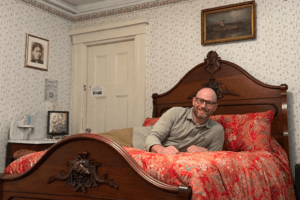
I was now nearly late for the main event: a tour of the Lizzie Borden house and a night sleeping alone in Lizzie’s bed. A room I had only ever seen on ghost shows.
What the hell was I thinking? Was a tour of the house not good enough? I had to choose to sleep in the bedroom of Lizzie Borden.
After picking up my ticket, I met my tour group at the front door of the Borden House. A man in a white shirt, a black vest, and a hatchet with bloodstains greeted us. He gave us a brief history of the house and an overview of the infamous 1892 murders, then opened the door—creaking as only a turn-of-the-century haunted house would.
Walking in felt like stepping back in time. Flower patterns on the wallpaper and floors, lace curtains, chairs with wooden borders, and pictures all screamed of yesteryear.
Walking through the rooms, we heard the story of the day the Bordens were so violently murdered, along with the theories and some haunted lore. A white sheet covered a couch in the parlor, with an arm sticking out from underneath. The tour guide gently pulled back the sheet, revealing the bloody, unrecognizable face of a life-sized mannequin of Lizzie’s father, Andrew.
I’ve always struggled with the sensationalism of real-life trauma, but this felt different. Looking at his face made me think of my days studying criminal psychology. That kind of violence seemed intimate, and competing theories about who had done it swirled through my mind. Was the mannequin necessary for the story to be told? It certainly helped the story to be felt. Maybe that is the point.
Digging deeper, why didn’t the mannequins and the tour guide holding an axe feel all that sensational to me? I think the dark tourism spectrum, proposed in 2006 by Dr. Philip Stone, one of the world’s foremost experts on dark tourism, might help explain it. In particular, the fact that the deaths occurred more than 130 years ago and were not connected to a larger political or ideological event, such as a war, moves the experience toward the lighter end of the spectrum. At that end, there tends to be more room for entertainment alongside history. At the same time, this was the actual site of the murders, and the tour guides and the experience as a whole leaned heavily toward historical accuracy rather than overt sensationalism.
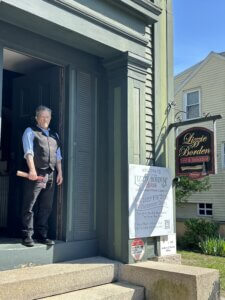
Although the Borden House is mostly tasteful in its approach, it is not perfect. Its gift shop, for example, sells a variety of items, some more tasteful than others. In the end, what bothered me most was realizing that I had played into the sensationalism myself—something I strive to avoid. I took a picture beside Mr. Borden’s mannequin while holding one of the fake axes sold in the gift shop.
It is just too bad that Andrew and Abby Borden are not able to have a say in how their stories are told. They are really the ones who should be at the forefront of the story.
We walked up the stairs and saw the bloodied mannequin of Mrs. Borden lying on the floor. Next to that room was Lizzie Borden’s bedroom. All I could think was, I’m sleeping here tonight. That is my bed. That was the first real jolt of anxiety. If Lizzie is still here, am I sleeping with Lizzie Borden? Or maybe I’ve just seen one too many ghost shows featuring this very house—and this very room.
As the tour ended, I received my final instructions and a bit of information I wasn’t expecting to hear. “There is one other room booked for the night, but they are not here yet. So until they arrive, you will have the house to yourself.” I wasn’t sure how to feel about that.
I unpacked and sat on Lizzie’s bed, taking in the historic weight of the room. The black-and-white portraits of Lizzie on the wall seemed to gaze back at me. After a few moments, I set out a couple of balloons—an old ghost-hunting trick I’d picked up in Gettysburg—to see if Lizzie might want to move one. No movement, so I decided to explore the house.
Walking around the creepy, haunted house, I retraced the tour’s route. Then I went back to the room to check the balloons—no movement. A couple of hours into the evening, I heard footsteps, as if someone was running. Am I hearing things?
With more anxiety setting in, I was standing next to the mannequin of Andrew’s body when running footsteps came straight at me. A child, only about ten years old, appeared and immediately started talking to me about the murders. Then his mother appeared. Over time, his older brother and father followed.
The other guests were in the house.
That evening, I found myself in the front living room of the home, sitting with the family. Sitting there, we discussed the haunted lore and the different theories we had as we ate our pizzas together.
We didn’t hear any strange noises, see any shadow figures, or witness any floating objects in the room. We just sat there, me and a family I had met only a couple of hours earlier, bonding as if we had been friends since childhood. I watched the older boy, a Rubik’s Cube prodigy, solve one in seconds.
As midnight approached, I headed to my room. I crawled into bed next to the balloons I could faintly see on the floor. Would they move? Would Lizzie crawl into bed with me? The thoughts rolling through my head became almost comical.
Then the next thing I knew, I was opening my eyes to the sun shining through the lace curtains. I had made it through the night. I did it—I slept in Lizzie’s bed!
I said my goodbyes to my new friends from Virginia Beach, then headed to the coffee shop.
I was expecting a haunted experience, but what I left with was something I never expected. I didn’t experience the spirit of Lizzie, but I got much more. I experienced empathy in that room, sleeping in her bed. A woman presumed guilty by many may have been innocent of one of the most heinous crimes. I felt her in a way I never could have imagined.
I also bonded with a family I never would have crossed paths with had we not shared a room and a pizza in one of the most haunted houses in the world. You arrive with an open mind and leave with an experience. I will likely never see that family again, but I will always remember the experience we shared. And that is worth more than seeing a shadow figure walk through a wall any day.