
Just a few miles from the M4 motorway, Caerleon offers one of the most complete glimpses into Roman Britain you can experience anywhere in the UK. It was once Isca, a major legionary fortress home to the Second Augustan Legion where around 5,000 soldiers who lived, trained and socialised here for over two centuries. Few places in Britain preserve this much of a Roman settlement in one walkable area: an amphitheatre, extensive bath complex, barracks, and a museum filled with objects from daily military life.
What makes Caerleon remarkable is how unexpected it feels. You leave the motorway, drive twenty minutes from Cardiff, and suddenly find yourself standing inside a Roman arena or tracing the outline of ancient plunge pools. It’s an easy half‑day trip and a natural companion to exploring the capital — especially if you’re already planning time in Cardiff.
The Amphitheatre: A Roman Arena in the Welsh Countryside
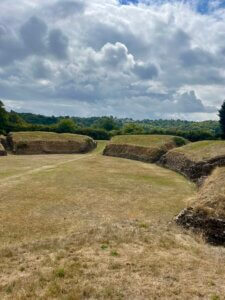
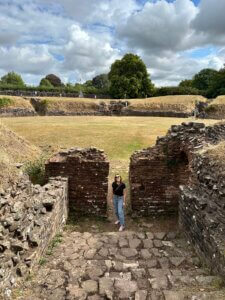
The amphitheatre is Caerleon’s most dramatic reveal. One moment you’re walking past quiet houses; the next you’re stepping into a vast Roman arena that once held up to 6,000 spectators. Built around AD 90, it was used for military ceremonies, training displays and large‑scale gatherings of the legion.
Its power lies in its simplicity. The earth banks rise around you, open to the sky, with no heavy reconstruction to distract from the atmosphere. It’s easy to imagine the thud of boots, the clash of shields, the noise of thousands of soldiers assembled here.
The Roman Baths: Everyday Life, Perfectly Preserved
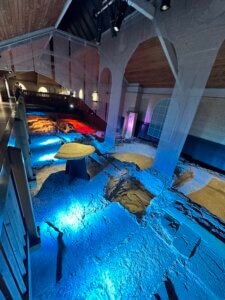
A short walk from the amphitheatre, the Roman Baths offer a quieter, more intimate window into daily life. This was the social hub of the fortress — a place to wash, exercise, relax and connect with others. The remains sit beneath a protective structure, beautifully lit to reveal the outlines of heated rooms, plunge pools and the enormous open‑air swimming pool.
The Baths are well organised with a wooden walkway and information points as you walk around. This helped to understand how the Baths were used and what an important part of life for the Romans that they were. From a practical perspective, entry was £6, which seemed reasonable given that the Museum and Amphitheatre were free to enter.
The National Roman Legion Museum: Objects With Stories
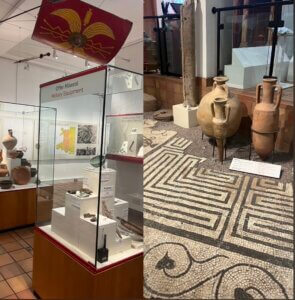
The museum is small but wonderfully curated. Rather than overwhelming visitors, it focuses on objects that illuminate the everyday realities of fortress life:
- Legionary armour — worn, dented, and unmistakably used
- Personal items — brooches, pottery, gaming pieces
- A reconstructed barracks room — showing how disciplined and communal life was for soldiers
My favourite exhibition was the reconstructed Roman flooring, which was wonderfully well preserved. When we visited we also got the chance to hold and learn about the Roman amour, which was fun.
The Barracks: A Glimpse Into Legionary Life
The barracks are one of Caerleon’s most evocative features. These long, narrow buildings once housed the legionaries in tightly organised rows of rooms — eight soldiers to a contubernium, sharing a small space for sleeping, storing equipment and preparing for daily duties.
Walking through the foundations, you can clearly see the layout:
- Front rooms for equipment and weapons
- Rear rooms for sleeping and living
- Orderly rows that reflect the discipline of fortress life
It’s a rare chance to stand inside the footprint of Roman military housing and imagine the rhythms of everyday life — the camaraderie, the discipline, the sheer closeness of living alongside thousands of other soldiers.
Closing thoughts
Caerleon is one of the most important Roman sites in Britain because it preserves so many layers of fortress life in one compact area. You can stand in an amphitheatre, walk to a bath complex, explore a museum of artefacts, and wander through the footprint of barracks — all within minutes. It’s rare to find a Roman settlement this complete, this accessible, and this atmospheric.
Its closeness to Cardiff makes it an easy and rewarding addition to any Wales itinerary. Caerleon offers a textured, deeply human encounter with Roman history — one that feels both grand and quietly intimate.