Dr Yvonne Waft, Clinical Psychologist and Guest Contributor
We all know that travel broadens the mind and is something many people aspire to for the excitement, joy and new experiences it brings. New places, new foods, new cultures and norms all bring a sense of novelty to life. Most of us seek that out from time to time as a contrast to the mundane, work-a-day reality we would otherwise live. Travel doesn’t have to be costly, many young people set off with little more than a backpack and a train ticket and still have incredible experiences. But what happens when travel is extra challenging? What is it like travelling as a disabled person?
As a full-time wheelchair user myself, and as a parent to a young adult with a birth-related brain injury, I face many barriers when it comes to travel. However, as someone who has always flatly refused to be “confined” or “bound” by a mere wheelchair, I have travelled the world, and I have tales to tell.
In my younger adult years, my travel was mostly in service of my participation in wheelchair basketball at international level. I travelled mainly in Europe for that but also to the USA for the Paralympics in Atlanta, Georgia in 1996. Travelling with a team, with similar disabilities, plus a support team of coaches and physios, meant we could learn tricks and tips from each other, and had support when things went wrong. I think looking back now this was a necessary training ground for my later exploits. Learning to manage less than ideal accommodation and seeing how wheelchair users are “handled” at airports within that supportive team atmosphere means that nothing surprises me now, and although I may get stressed and angry at times, I know it is usually just a temporary state and I will survive it.
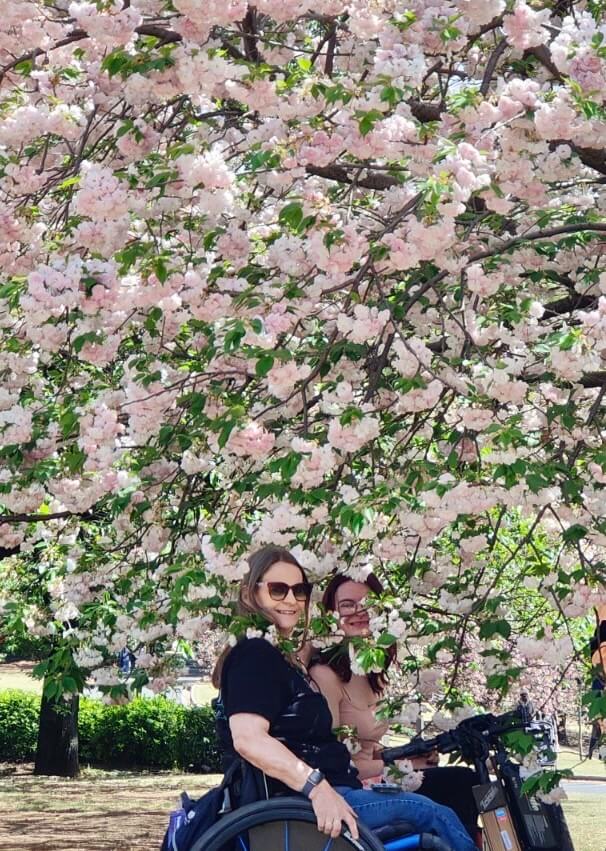
Once I had retired from international sport, I got married and we began travelling when we could, often by car to France in those early years. We had my daughter and progressed in our careers, me as a Clinical Psychologist, and my husband as a teacher. We gradually started to be able to afford more adventure as time went on. We flew to Bordeaux, Barcelona, Prague, Rome, Toronto, Krakov, Budapest, Paris, Iceland, to name but a few of our almost annual trips abroad. We planned to visit Tokyo during the 2020 Paralympics to watch the wheelchair basketball, but our initial plans were scuppered by the COVID-19 pandemic. Our partially paid for trip ended up happening in April 2023 with a trip to Tokyo and Kyoto, with no Paralympics, but cherry blossom in abundance instead, which seemed a fair trade off. More recently two of our nieces, living in the USA, got married, necessitating two transatlantic trips within 10 months of each other. Obviously, we made a proper trip out of each of those. If you are going that far, you might as well spend some time and see the place properly. One involved a week in San Francisco, and a weekend in Santa Cruz, with the actual wedding taking place on the side of a mountain in a redwood forest, in about 40ºC heat – which was toasty! The other wedding involved a few days in New York, a long weekend in Virginia Beach for the actual wedding, and a week in Chicago.
I am sure this all sounds very wonderful and we do indeed feel extremely privileged to have been able to travel so extensively. In fairness, we have worked very hard to have that privilege. The bit people don’t see, however, when I post my impressive holiday pics on Facebook or Instagram is the work that goes into even booking a trip as a disabled family, and the indignities we face along the way.
Our first hurdle is that for various reasons, we need a family room. I use a wheelchair full-time, so I need a wheelchair accessible room so that I can move about, and shower safely. Wheelchair accessible family rooms do not exist in many countries of the world. You can be a family, or you can be disabled. You can’t be both, according to the hotel trade industry! This makes booking a hotel a very stressful and time-consuming business. You cannot book online as you need to speak to a human and establish exactly what is available and even then, it goes wrong. One example of how this plays out was in Tokyo in 2023. Lovely hotel in the shopping district, good sized family room, but a 7” step into the bathroom! After much protestation, they moved us to a larger suite, so we had more room, however there was still a substantial step into the bathroom. Further protestations established that there was an accessible room, but it could only sleep two people. Our choice was either to book the accessible room and one other room, incurring a significant additional cost, or manage. We managed. This trip had already cost us an eye-watering amount, so adding even more cost just wasn’t possible at that moment. So, for the duration of our time there, I transferred onto the bathroom floor from my wheelchair, pulled my chair up the step, used a small stool from the room to lift myself back up into my wheelchair. The upside of this was that I didn’t need to use the gym for the week as I was getting my workout just going for a pee and a shower in the morning. I am getting older though. I’ll be 60 next year and I’m already aware that my shoulders no longer tolerate the same level of abuse they have taken over the last 40 years of wheelchair use.
To balance out the hotel trauma in Tokyo, the city had the best accessible transportation system I have ever come across! We only had to rock up at a Metro station, and a uniformed staff member would appear with a ramp to assist us over the miniscule gap onto the train. We could have managed without them but didn’t want to be rude. They also seemed to magically know where we needed to get off as there was always someone waiting with a ramp, even if we hadn’t said where we were going. The level of accessibility and service throughout Kyoto and Tokyo was exceptional – apart from the step in the hotel rooms. You win some, you lose some!
We nearly always end up gambling on a family room being vaguely accessible as we should not have to pay for 2 rooms when other families can book a family room for little more than the cost of a standard room. On a recent trip to London, we had booked a family room for the weekend, only to find out it was absolutely tiny. Literally not enough space for me to even enter the room, two steps up to the sleeping area, and a shower room so small you could literally sit on the loo, wash your hair with the shower and clean your teeth in the basin simultaneously. This was completely unworkable and the only solution was to book the accessible room in addition. The accessible room would only sleep two, so I had to share with my daughter in the accessible room and leave my husband in the tiniest family room you have ever seen. As it was central London, Pride weekend, and a bit of an urgent situation it cost us over £500 extra to have the additional room. It becomes a kind of disability tax no-one tells you about!
The other major hurdle we face is navigating airports and airline travel. Allow me to talk you through a typical journey. The first issue is that we have a big wheelchair accessible van that doesn’t fit in most multistorey car parks. So, time is spent trying to locate a car park without a height limit (2.4m, in case you’re wondering). If no such car park exists, the next challenge is to find a taxi big enough such as an 8-seater minivan (amounting to considerably more “disability tax”). That is unlikely to be a wheelchair accessible taxi however, as those are typically quite small vans, just designed for one wheelchair user, not an entire family with 2 sets of mobility equipment and luggage for a fortnight away. The taxi we get will be a minivan that I need to clamber into in a fairly undignified way, while my chair and other equipment is stowed in the boot.
Sometimes on arrival at the airport we are ushered straight to an “assisted travel” check in desk. This happened at Heathrow when we went to San Francisco 2 years ago. The assisted travel queue was extremely long and very slow. We had arrived at the airport 3.5 hours before our flight. We queued for over an hour to check in. At check in our luggage booking hadn’t been put on the system, a random admin error that could happen to anyone, and the check in man spent over 45 minutes on hold to his own office to rectify this as he couldn’t take our luggage unless it was on the system. After check in, there is another stage other people don’t have to do. We have to make ourselves known to the Assisted Travel desk and repeat all the information we just gave the check in agent about our chairs and what help we need with boarding. Next stop, security. Security as a wheelchair user is a most unpleasant experience.
Nobody enjoys going through security, it’s stressful and chaotic at the best of times, but for us it’s way harder. My daughter has learning disabilities and autism as well as physical disabilities, so she finds the whole thing highly stressful and struggles to communicate in that situation. We can’t go through the security scanner in our wheelchairs, so we have to go through a separate gate and be patted down physically and have our chairs swabbed for drugs or explosives. They will always find a female staff member to pat down a female traveller, but even so, it is always quite a “thorough” search and can feel extremely intimate and intrusive.
By the time we’re through security, it seems, regardless of how much contingency time we gave ourselves, we rarely have time to browse the airport shops or get something to eat. We are always told to be at the gate at least 30 mins before the flight time and if we don’t there’s no guarantee we’ll be loaded on first. If we have already spent over 2 hours getting checked in, reporting to the Assisted Travel desk and through security, we’re going to be running short of time, unless we have somehow managed to check in before the check in desk has opened. At the door of the plane, my daughter will get out of her wheelchair and walk onto the plane. Whilst I need to be assisted onto the plane using the aisle chair, which really needs to be done before everyone else piles on with their carry-on bags and kids. By this point I am separated from my trusty chariot, my only means of mobilising in the world. I have left it in the hands of strangers to be placed in the hold, carefully and safe from damage. I hope. I have heard many horror stories of wheelchairs going missing, or being damaged beyond repair by airline staff and it fills me with dread every time I fly. As yet, the worst I’ve experienced is superficial scrapes and damaged paintwork and for that I am very thankful.
You might be wondering, if it’s that stressful and things go so wrong, why do we even bother? Well, I ask myself the same thing sometimes. The thought of booking somewhere initially seems exciting and fun. Then the “what if” thoughts start. What if we lose a wheelchair? What if the room is inaccessible? What if we miss our flight because the check in system fails us? As a Clinical Psychologist, I recognise this type of anxious “what if” thinking and remind myself that whilst we have had issues on trips, we have so far always survived it and eventually laughed about it. In Prague one year, the main entrance to the hotel was up some steps, but there was a delivery bay with a platform lift round the back which they deemed appropriate for their disabled guests (I would beg to differ). Two days into our holiday the platform lift broke down and did not get fixed for the duration of our stay, so my husband had to manhandle mine and my daughter’s wheelchairs up the steps into the hotel every day. When we repeatedly complained we were told they were doing their best to get it fixed. Finally, when we checked out, I complained again and they said it was out of their control. I asked to speak to a manager and negotiated a substantial refund on our bill. So even when difficult things happen, there can be an upside. Similarly, after the Heathrow – San Fran check-in debacle in 2024, I complained to BA and eventually was issued with a voucher to compensate us for the inconvenience. It had a short expiry date which forced us to make the trip to Dubai in 2025, where our check in experience was as smooth as could be. It’s fair to say, I do always look for the upside despite feeling very stressed and upset in those moments.
I think, for me, the whole point of travel is to see new places and have different experiences. As a disabled family, that comes with a degree of risk that most people don’t face in this day and age. We have the choice to stay home and save ourselves the hassle and money of course. However, I feel we would be missing out on so much then. I can say I have seen the cherry blossom in Japan, I’ve swum in the Persian Gulf, I’ve celebrated New Year’s Eve in Reykjavik, and so much more. These are the experiences that make life worth living for me and so far, the hiccups we’ve had over accessibility and air travel have not been enough to make me want to stop. I might try Greece next, I’ve never been there…
Author biography
Dr Yvonne Waft is a UK Registered Clinical Psychologist and EMDR Consultant. Having worked in secondary care adult mental health in the NHS in West Yorkshire for many years post-qualifying, she now runs a busy online private practice, Catalyst Clinical Psychology Ltd. Trained in many therapeutic approaches including EMDR, ACT, CBT, & CFT, Yvonne works mainly with people with complex trauma presentations and supports other professionals in their work with trauma through teaching, training and clinical supervision. In December 2023, Yvonne published her first book “Coping with Trauma – surviving and thriving in the face of overwhelming events”, which takes a personal and professional perspective on understanding trauma and how to deal with it.