By Kora Dietsche, Trainee Psychotherapist and MSc Psychology graduate
I enjoy travelling slowly, often by train or bus, on foot, and spending longer periods in one place when possible. I also often travel alone and value the variety, from day trips and multi-day hikes to several weeks or months in the same location. For me, this way of travelling simply feels good.
What matters most to me is the quality of the experience. “Slow” in Slow Travel is less about pace and more about attitude—creating space to notice, connect, and tune into my own needs. I experience this as a more grounded and fulfilling way of travelling, one that allows for both ease and depth.
For me, this way of travelling is closely linked to a resource-oriented relationship with oneself: paying attention to what restores energy, what feels right, and what creates a sense of balance. I believe that this kind of awareness can also shape how we relate to the world around us—making our experiences more intentional and meaningful. I feel most at ease when I spend time in one place, observing what’s around me—what I think of as wandering with curiosity. Moving without rushing, I begin to notice details I might otherwise miss, and my attention settles in a way that feels both grounding and expansive.
Through sharing my experiences, I invite you to reflect on your own way of travelling and to discover what feels most enriching for you.
What does slow travel mean from a psychological perspective?
In tourism research, slow travel is often described as travelling differently: visiting fewer places, staying longer and engaging more deeply with an environment.
From a psychological perspective, travelling more slowly means our senses are less overloaded. Sensory information from the environment – received through our eyes, ears, skin, nose and taste – must be processed by the brain. When fewer stimuli arrive simultaneously, the brain has more capacity available for attention. To put it another way, when we slow down we have capacity to notice things that we wouldn’t otherwise have noticed.
Attention can be understood as directed perception – a conscious decision about where we focus our awareness (Posner & Petersen, 1990). What lies outside our attentional focus often barely exists in our experience. Only when we direct attention toward something does it become part of our conscious world.
The important lesson is this: When our attention changes, the way we perceive the world changes as well. This is why I find it fascinating to return to the same place after several years. The place may not have changed much – but my perception often has. My attention is drawn to details I may not have noticed before.
This shift is closely related to what Jon Kabat-Zinn describes as mindfulness: paying attention on purpose, in the present moment, without judgement (Kabat-Zinn, 2005). Ellen Langer adds another dimension: actively noticing new things, remaining open to different possibilities (Langer, 2023).
Another useful concept comes from environmental psychology. The Attention Restoration Theory suggests that natural environments and soft fascination (a form of gentle attention evoked by water movements, drifting clouds, leaves in the wind, or the subtle sounds of the surroundings) can help restore depleted attentional resources (Kaplan & Kaplan, 1989). It is thought that this soft fascination is an important part of the restorative benefits of travelling (Packer, 2021).
Perhaps you have experienced this yourself: As we move more slowly and are exposed to fewer stimuli, we often begin to notice more details – sounds, patterns, the play of light and shadow, or the rhythms of a place.
Instead of moving from one attraction to the next, space emerges for observation. For me, this state is connected with curiosity, presence and a sense of playful discovery. In slow travel lies a quiet invitation: to see the world with attentive eyes.
The power of observation
Observing mindfully is a skill that we can learn. When travelling, I like to sit in a market and simply observe what is happening. I might choose a particular object and look at it carefully: its shape, its colour, perhaps even its smell. I am often surprised how relaxing it can be to focus attention deliberately and simply observe — without immediately evaluating what we see.
Mindful observation means noticing without needing to form an opinion. This does not mean suppressing thoughts, it means noticing them.
This is one of the quiet gifts of slow travel: the time and space to observe.
The power of observation lies in the fact that it is intentional and active — yet non-judging. And precisely this can create the inner space and quiet that we all want to have.
Slow solo travel
Slow travel can become particularly meaningful when experienced alone. Being outside our familiar environment creates distance from the social contexts that usually shape our identity. Without the roles we inhabit at home, we may begin to ask different questions:
Who am I outside my usual environment?
What parts of myself become louder or quieter here?
Travelling slowly can create the psychological space for this kind of reflection. With fewer external stimuli and fewer social expectations, we often have more time for introspection, observation and to explore who we are.
In these quieter moments and open spaces, we can consciously strengthen parts of ourselves that we may not have much time for in everyday life — or even begin to notice them for the first time.
For example, if we would like to feel comfortable doing things alone, travelling alone can be an opportunity to practise this. Because nobody knows us, it can feel easier to experiment with new behaviours. Over time, these experiences can help us to build confidence to bring these changes back into our lives at home.
My path to slow travel
I’ve come to realise that my attraction to slow travel is not accidental.
Before I had a name for it, I noticed how overwhelmed I felt by tightly planned trips. Moving quickly from one place to another often left me strangely disconnected, as if I had seen a lot but experienced very little.
Slowing down, for me, is less a philosophy and more a way of settling my attention. But it wasn’t always easy. Travelling without a plan brought moments of restlessness — the urge to check something, to move on, to make the moment “useful.” Psychologically, this makes sense: our minds are conditioned to seek stimulation and structure.
What changed things was practice. As I allowed myself to slow down, my discomfort gradually eased. I became more able to “go with the flow,” and I realised something important: slow travel is not simply a preference — it’s a skill that develops as our attention adapts to a different pace.
With time, spontaneity began to feel like a form of freedom — grounding, empowering, and deeply connective.
Slow travel now offers me a counterbalance to the efficiency of everyday life. It reminds me that meaning often emerges when we stop trying to optimise every moment.
Why can slowing down be so difficult?
If slowing down is so beneficial, why does it often feel so hard? Part of the answer lies in how we have learned to travel. We are used to consuming places and not inhabiting them.
Trips are organised around efficiency: what to see, how much to fit in, how to optimise time. There is a quiet pressure to make the most of every moment and the fear of missing out. Slowing down can feel unproductive and there is a discomfort that comes with this in a world shaped by constant stimulation.
And yet, slowing down can bring us so much richness and depth.
A personal example: Walking the Maltese coast
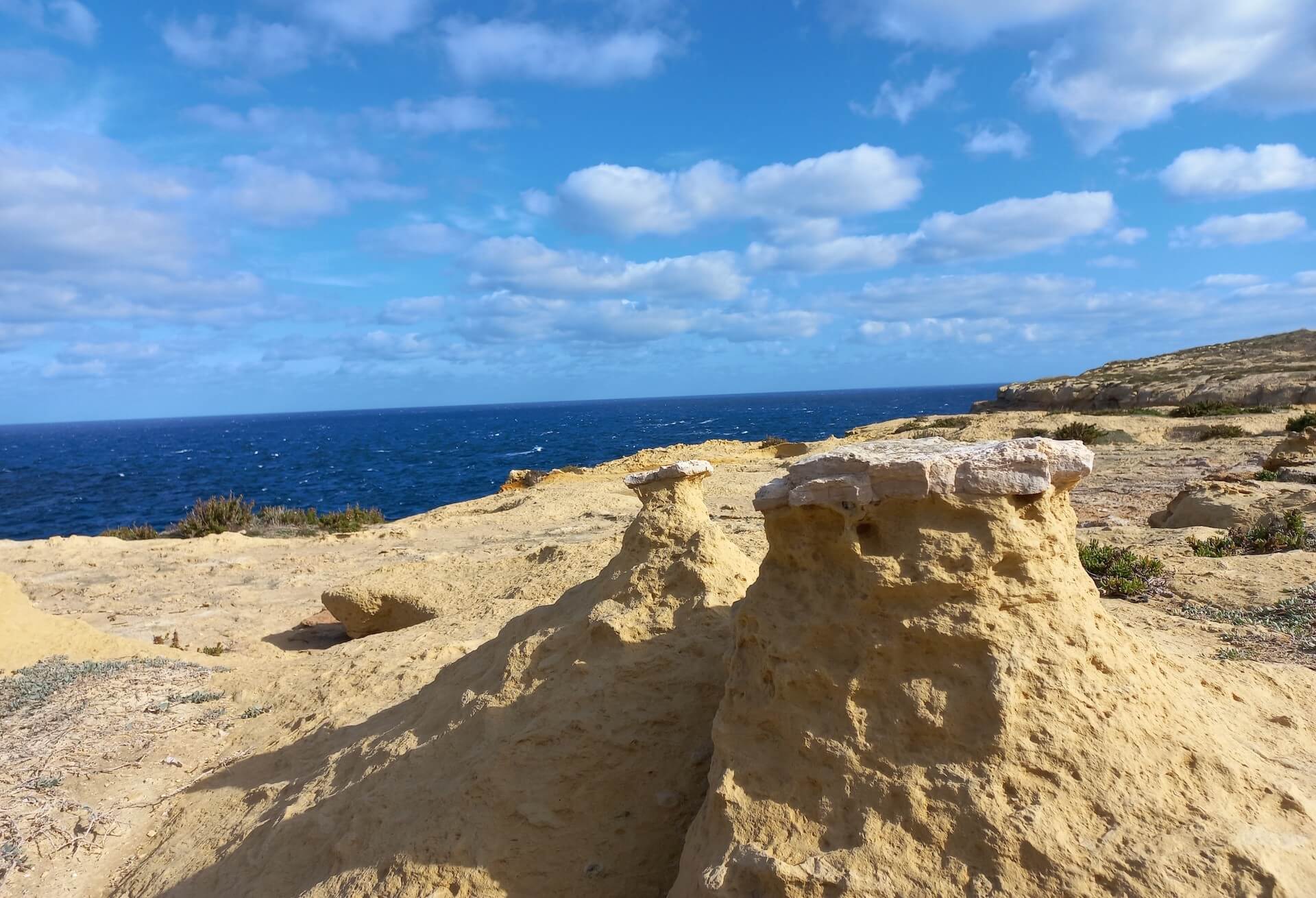
It was January, and I was walking along the coastal paths of Malta. The wind was strong, the sun warm, and clouds moved quickly across the sky. Strange rock formations rose in front of me — like small tables overlooking the sea.
I sat down.
No one else was there. I had all the time in the world.
I celebrated peace and slowness.
I don’t remember how long I’ve stayed. But something settled inside me — a feeling of openness, of aliveness. I closed my eyes and felt the wind on my face, the warmth of the sun on my skin.
At the same time, the moment made me aware of my own finiteness. The rocks, the sea, the wind – they had all been here long before me and will remain long after I will be gone.
In moments like these, travelling becomes less a movement through places and more a movement of attention.
How to begin to travel more slowly
If you’re curious about travelling more slowly, it can be helpful to start with small, intentional adjustments. Even a slight reduction in pace gives your attention more room to settle, making it easier to notice details you might otherwise miss. Staying longer in one place can deepen this effect, allowing your mind to shift from “collecting experiences” to inhabiting them.
You might also experiment with walking without a clear destination. Psychologically, this invites a different kind of attention — one guided by curiosity rather than efficiency. Leaving parts of your day unplanned can have a similar impact, creating space for moments that feel spontaneous and restorative.
Another gentle practice is to observe before documenting. When you pause to take in a scene without immediately reaching for your phone, you give your mind time to form a richer memory. And returning to the same café or familiar corner can create a sense of grounding, offering a small point of continuity in a new environment.
Slow travel doesn’t require a complete shift in identity. It often begins with simple practices that help you attend to the world — and to yourself — in a different way.
Closing Thoughts
In the end, slow travel is not just about doing things differently, it’s about noticing with intention.
It’s less about where you go, and more about how you attend to your experience , and who you become in the process.
References
Posner, M. I., & Petersen, S. E. (1990). The attention system of the human brain. Annual Review of Neuroscience, 13, 25–42. https://doi.org/10.1146/annurev.ne.13.030190.000325
Kaplan, R., & Kaplan, S. (1989). The experience of nature: A psychological perspective. Cambridge University Press.
Kabat-Zinn, J. (2005). Gesund durch Meditation. München: O. W. Barth.
Langer, E. J. (2023). The mindful body: Wie Achtsamkeit Körper und Gesundheit beeinflusst. München: Verlag Franz Vahlen.
Packer, J. (2021). Taking a break: Exploring the restorative benefits of short breaks and vacations. Annals of Tourism Research Empirical Insights, 2(1),
Pirsig, R. M. (1974). Zen and the art of motorcycle maintenance: An inquiry into values. William Morrow.
Potts, R. (2022). Vagabonding: An uncommon guide to the art of long-term world travel (20th anniversary ed.). Ballantine Books.