

By Dr Charlotte Russell, Clinical Psychologist
We’ve all been there: the trip you dreamed about turns out to be underwhelming. The weather doesn’t cooperate, the hotel isn’t what you expected, or the destination simply doesn’t live up to the hype. Disappointment can feel like wasted time and money — but it doesn’t have to end your journey. With the right mindset, even a “bad” trip can offer insight, growth, and joyful moments.
What is Disappointment?
- Disappointment is an emotion that arises when reality doesn’t match our expectations.
- In travel, this often means the destination, experience, or atmosphere feels less exciting or fulfilling than imagined.
- It’s not just about the trip itself — it’s the gap between what we hoped for and what we actually encounter.
What Happens When We Don’t Deal With It Well
- If left unchecked, disappointment can spiral into frustration, resentment, or a sense of wasted time and money.
- It may overshadow the entire trip, making it harder to notice small joys or unexpected positives.
- Psychologically, it can reinforce negative thinking patterns, leaving us less open to future experiences.
- In relationships, it can cause tension with travel companions if blame or criticism creeps in.
What might cause travel disappointment?
In my recent Instagram poll 82% of those who responded had experienced a holiday disappointment. The top reasons for this (based on this very small and unscientific sample) were unexpected issues at the destination and/or the person just didn’t connect with that particular destination.
In line with the kinds of disappointments that happen in everyday life, causes of disappointments can vary hugely. The website Get Away Today have listed Common Vacation Problems including missing flights, planning too much or too little, disliking the hotel, getting sick, bad weather, or hidden costs. We can see that experiencing any of these on your long-awaited holiday would be disappointing and frustrating.
I also asked our Instagram community whether they had been able to ‘make the most’ of their trip despite the disappointments they experienced. Their responses were interesting:
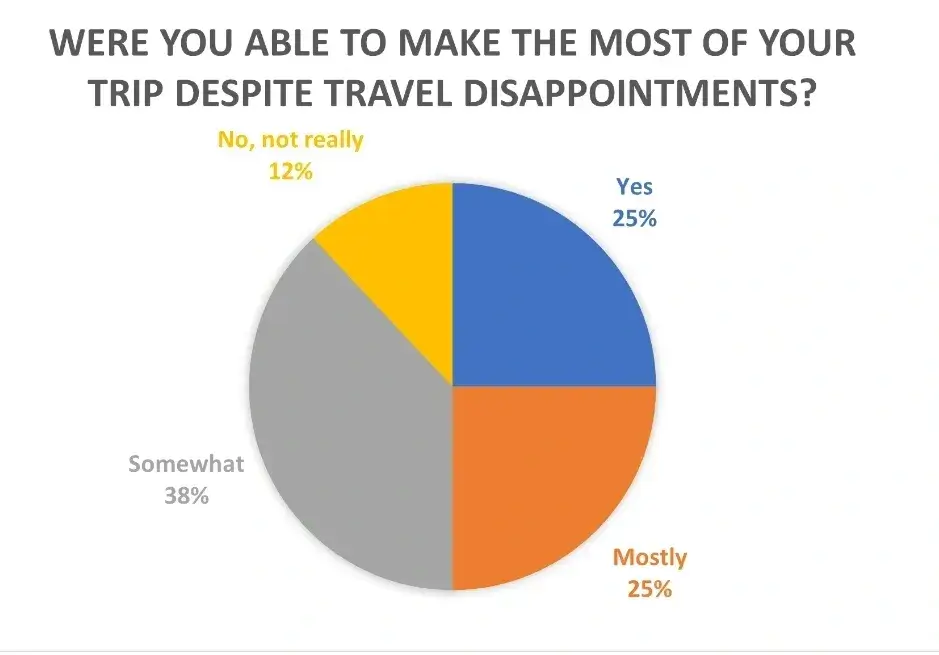
The responses suggested that people varied in how much they were able to make the most of their trip despite feeling disappointed. This of course may be related to the nature of the situation that they were dealing with! However it also suggests that having ways of managing disappointment in order to make the most of our trips can be beneficial. More on this later.
Importantly the majority of those who took part (86%) felt that they learned from their holiday disappointment on future trips. Like anything in life taking learning away from things that haven’t gone well is really important. This can help us to plan future trips and help with our personal growth.
Tips for managing holiday disappointments
So disappointments unfortunately are sometimes going to happen. Here are some tips for making the most of your trip even when disappointments occur:
· Prior to your holiday remind yourself that it even if you have invested a lot in the trip, it is unrealistic to expect everything to go perfectly and to feel 100% happy all of the time . This is a recipe for being disappointed. One way to mitigate this is to think in advance about how you might ‘reframe’ or view any challenges. For example, seeing the hassle getting through airport security as ‘worth’ the chance to get away. It can also help to think about how you might want to respond if things go wrong, for example committing to being calm and constructive if things do not go as hoped.
· Recognise that disappointment is an understandable reaction when things aren’t as hoped. It is more helpful to acknowledge the difficult feeling than to try and avoid or suppress it.
· Be specific in what you’re disappointed by and recognise what you can still make the most of. When the hotel breakfast is not great it is easy to think “This hotel is completely rubbish and my holiday is ruined”. Its more helpful to think “well the breakfast isn’t great and that’s disappointing but the room is comfy and it’s in a good location, so I’ll make the most of it”
· We can reduce the chances of fixating on the negatives by intentionally focusing on the positives, for example, naming and recounting experiences that we are grateful for on each day of our holiday. It can also help to stay fully ‘present’ for the small everyday pleasures during your holiday by using techniques such as mindfulness.
· Find something you do like at the destination and stick to it. I’ve actually had a couple of holidays where I just didn’t connect with the destination. On both trips however I did manage to find a restaurant and district that I did enjoy, and I just spent more of my time there. There’s always something that we can find to connect with, even if the overall vibe of the destination doesn’t fit for you.
· Remind yourself that there will be more opportunities to travel in the future and this trip is not your only chance to get things perfectly. This can help us to step out of the ‘scarcity’ mindset that is usually quite unhelpful for us.
· Remind yourself that we have to try different things in life to decide whether they are right for us. Same thing goes for travel. If we realise that a specific type of trip, destination or hotel type isn’t right for us then we can take this information and use it to improve our trip next time. Over time we get to know what suits us best.
· Focusing on the positives can also help. Acknowledge the experiences that you’re grateful for on each day or your trip. Also try to stay ‘present’ the small everyday pleasures like the feeling of calm when you’re sat drinking your coffee, or the sensation of the waves on your toes and feet. You may not have the best table for breakfast, but I’d bet that it’s still a step up from where you eat breakfast at home.
Final Thoughts
Disappointment is an inevitable part of travel (and life), but it doesn’t have to define your journey. When expectations fall short, it’s a chance to slow down, notice the small details, and connect more deeply with yourself and the world around you.
Every trip, even the ones that don’t go to plan, offers something valuable: a story to tell, a lesson learned, or a moment of unexpected beauty. By reframing disappointment as part of the adventure, you give yourself permission to enjoy the imperfect, the surprising, and the real.
So if your travels don’t unfold exactly as imagined, remember: the journey is still yours. And sometimes, the trips that challenge us most are the ones that stay with us longest.